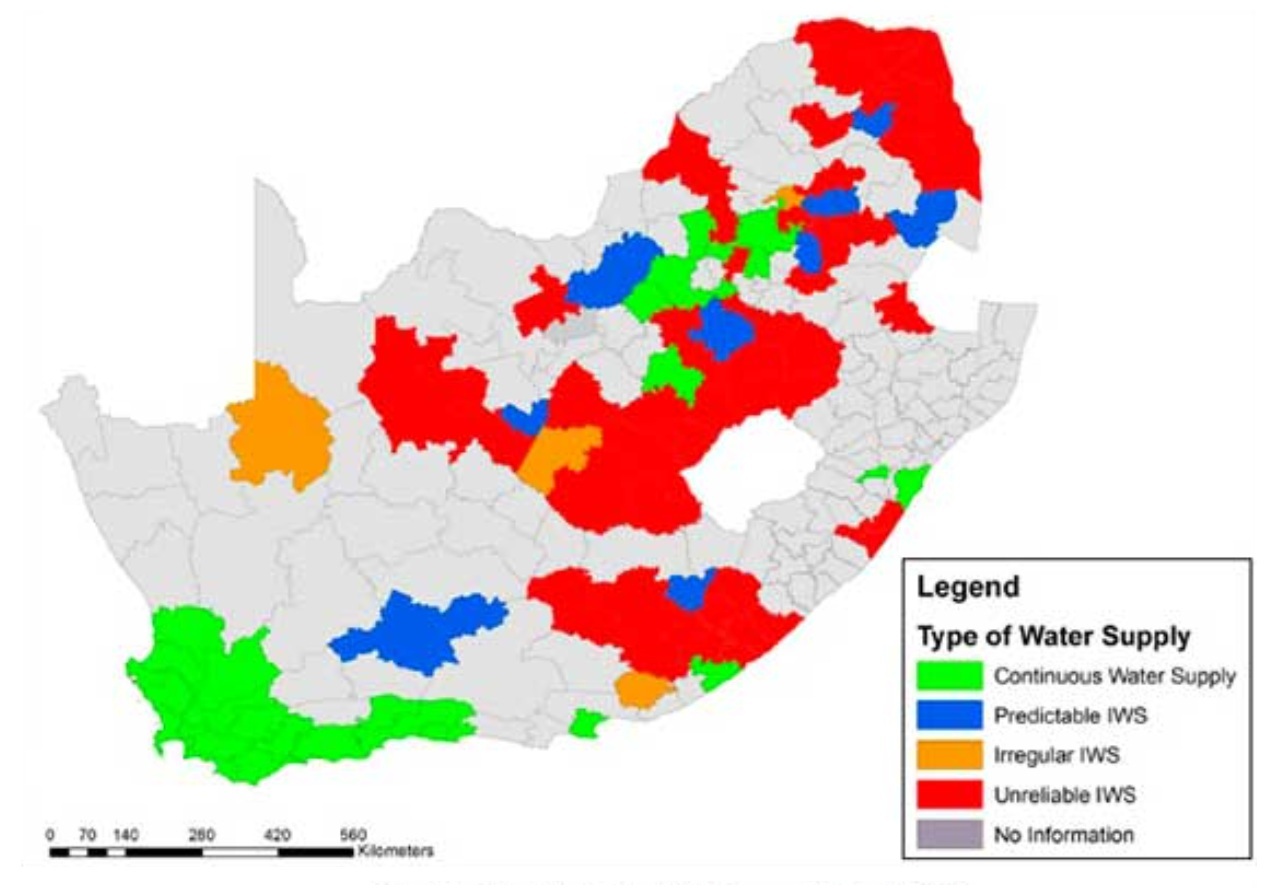
Intermittent Water Supply (IWS) represents a critical challenge in South Africa's water infrastructure. Research from Water SA (2021) and the Department of Water and Sanitation Master Plan (2018) reveals the widespread nature of this issue across the country.
The maps displayed show three key aspects of water service delivery:
1. Municipal Water Service Types: The first map categorizes municipalities by their water supply reliability, showing areas with continuous supply (green), predictable IWS (blue), irregular IWS (orange), and unreliable IWS (red). Notably, 65 of South Africa's 231 municipalities supplied water intermittently, while 32 had continuous supply and 134 had insufficient data.
2. Service Reliability by Province: Provincial reliability varies significantly, with Western Cape achieving 87% reliability, while provinces like Mpumalanga and KwaZulu-Natal show concerning reliability rates of 63%.
3. Population Impact: The third map illustrates the percentage of population affected by IWS in 2017, with some regions showing over 50% of residents experiencing intermittent supply.
This data underscores the urgent need for infrastructure investment and capacity building to ensure reliable water access for all South Africans. The connection between water security, economic development, and community welfare is clearly demonstrated through these spatial analyses.